
Próspera vs Delaware LLC: Costs, Taxes & Business Setup

If you are forming an international company, expanding an existing business, or structuring a multi-entity corporate setup, Próspera and Delaware are two jurisdictions built around very different commercial strengths. Choosing between them, or deciding how to combine them, requires looking closely at total formation and maintenance costs, tax frameworks, compliance obligations, and operational protections.
This guide compares Próspera and Delaware LLCs across each factor, detailing setup costs, tax implications, and operational realities. We will also examine how modern founders use hybrid setups, operating entities in both jurisdictions, to access US markets while optimizing digital operations.
Key Takeaways
- Founders frequently operate a Delaware LLC for US-facing client contracts alongside a Próspera entity for international operations, R&D, or digital asset management.
- Próspera utilizes an effective 1% tax on gross business revenue, whereas a Delaware LLC functions by default as a pass-through entity where profits flow through to members
- Próspera entities can be registered remotely via Tools for the Commons starting at $150, while Delaware charges a $110 initial state filing fee plus a mandatory $400 annual state franchise tax.
- Delaware provides century-old corporate legal stability; Próspera provides a flexible common-law regulatory sandbox optimized for tech, innovation, and digital business
Próspera vs Delaware LLC at a Glance
What Is a Próspera Company?
Próspera is a Zone for Employment and Economic Development (ZEDE) located on the island of Roatán, Honduras. Designed as a next-generation hub for global commerce, it operates under an autonomous common-law legal system, its own regulatory framework, and an independent tax regime.
Entrepreneurs can form an autonomous limited liability entity or register an existing foreign company remotely. For international agencies, tech platforms, and cross-border consultancies, a Próspera entity allows you to operate under an agile, business-friendly system without requiring physical relocation.
Through digital platforms like Tools for the Commons, founders can establish and manage these entities seamlessly from anywhere in the world.
How Much Does a Próspera Company Cost?
Próspera provides an affordable corporate maintenance structure, particularly for international founders who want to avoid high fixed state fees.
Specialized or highly regulated physical industries (such as healthcare or construction) require custom underwriting based on risk tier. Virtual digital companies are exempt from resident liability insurance.
When you register through Tools for the Commons, you pay the direct statutory rates without third-party incorporation markups. TFTC bundles the registration, registered agent workflow, and company administration dashboard into a single interface, avoiding fragmented vendor bills.
How Are Próspera Companies Taxed?
Unlike traditional corporate tax systems that require tedious year-end expense audits and deduction disputes, Próspera calculates corporate income tax strictly on gross revenue.
Under Próspera’s published tax code, 10% of gross revenue is treated as taxable income, and that taxable portion is taxed at 10%. This creates an effective business income tax rate of exactly 1% of gross revenue.
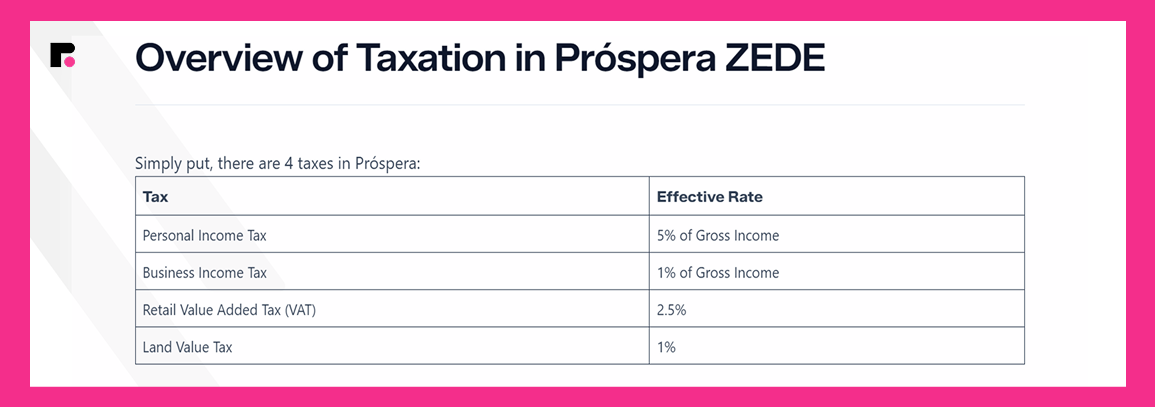
For example, if a company earns $100,000 in gross income subject to this tax, 10% ($10,000) is treated as taxable income. The 10% tax rate applied to that amount gives a tax bill of $1,000.
For high-margin remote companies, this predictability eliminates weeks of accounting reconciliation and preserves operational capital.
Note that corporate-level taxation in Próspera does not automatically override your personal tax obligations. Where you reside, where your directors manage operations, and your local controlled foreign corporation (CFC) rules dictate your personal tax position. Consult a cross-border tax specialist regarding your home jurisdiction.
How Do You Set Up a Próspera Company?
Incorporating in Próspera is entirely paperless and can be completed in minutes through Tools for the Commons:
1. Create an Account: Set up your founder profile on the Tools for the Commons portal.
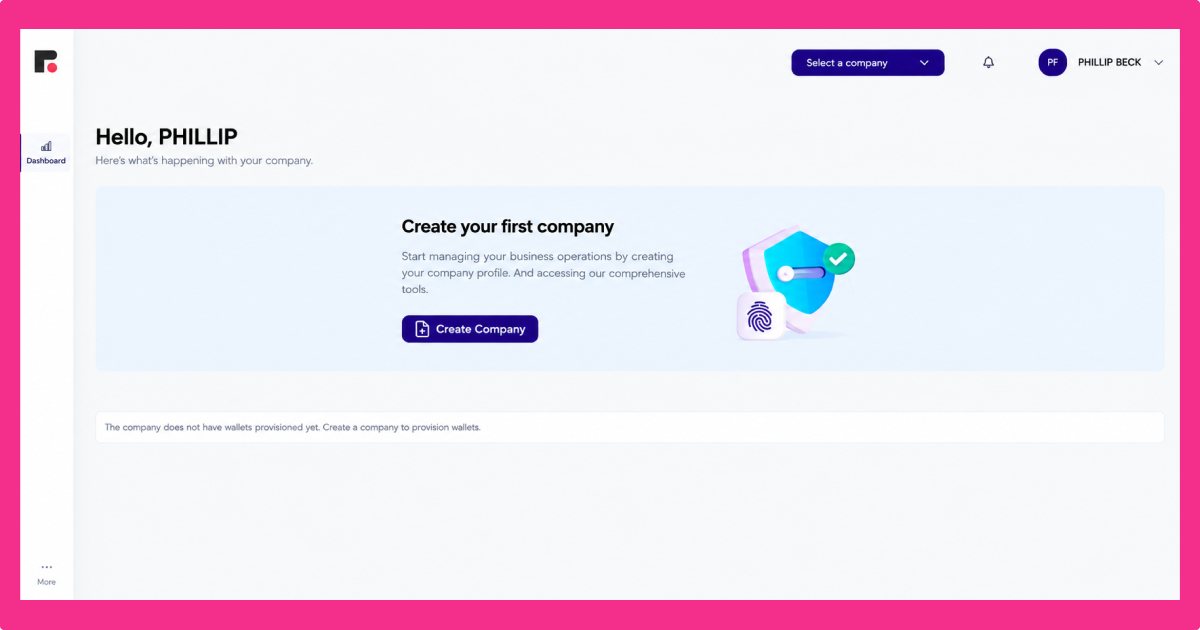
2. Complete Digital KYC: Upload a valid passport or government ID and complete the automated biometric liveness check.
3. Submit Entity Details: Select your entity type (LLC or Corporation), input member/manager structures, and provide your operational overview.
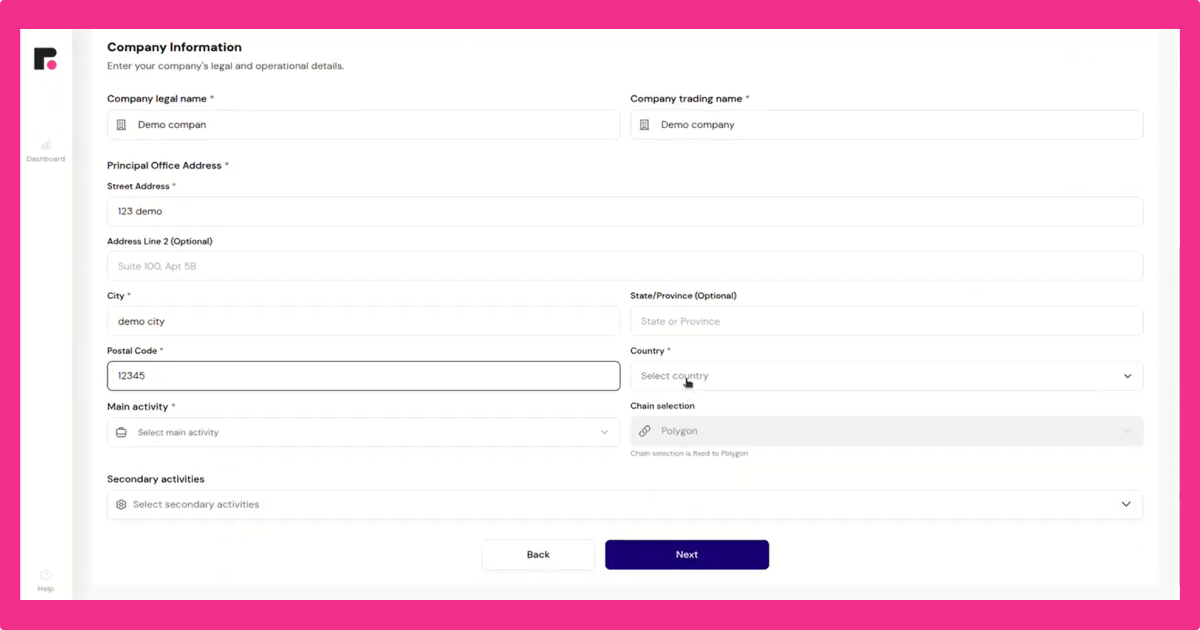
4. Instant Filing & Document Delivery: TFTC coordinates your filing directly with the zone registry.
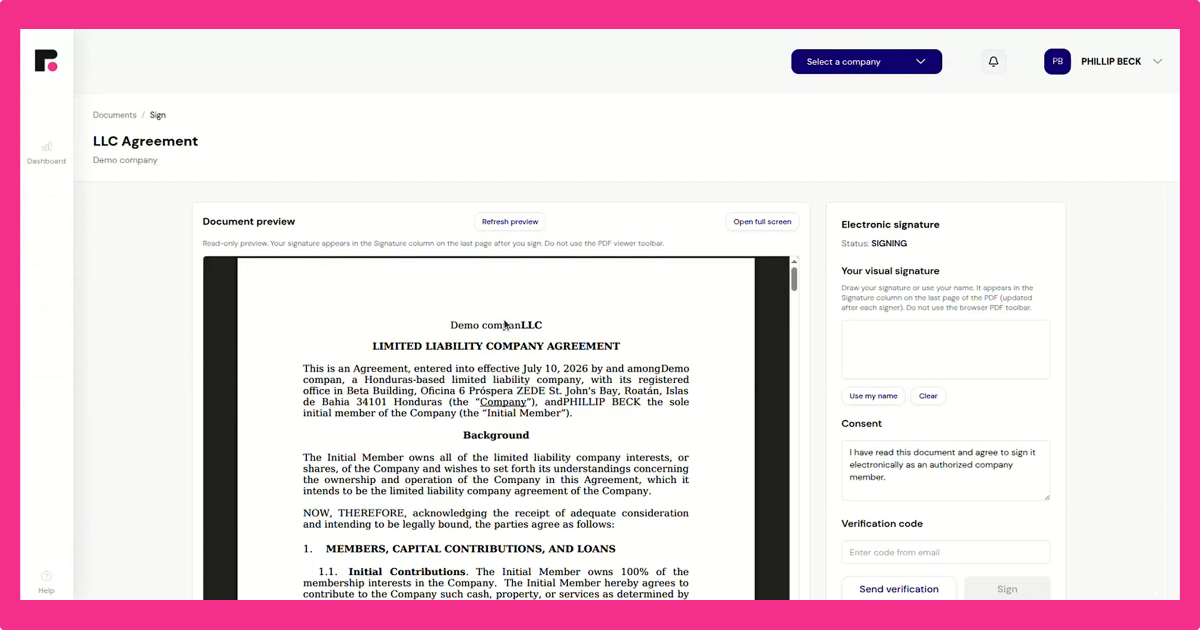
Once approved, corporate statutes, registry certificates, and company identification documents appear directly in your dashboard and inbox.
Banking, Governance, and Considerations for Próspera
Registering a Próspera entity does not automatically guarantee access to merchant accounts or Tier-1 US fiat bank accounts. However, businesses operating within Próspera can access modern fintech rails, international multi-currency accounts, and digital asset processing.
Tools for the Commons provides integrated operational tools that help registered businesses manage invoices, track multi-currency balances, and handle global pay-ins and payouts efficiently.
Regulatory Protections
Próspera resolves commercial disputes through the Próspera Arbitration Center, which uses modern common-law procedures.
Although the Honduran Supreme Court challenged the constitutional laws underlying Próspera in September 2024, the jurisdiction continues to rely on its 50-year Legal Stability Agreements and protections under the US-Honduras Bilateral Investment Treaty (BIT).
For early-stage tech ventures, digital consultants, and Web3 builders, Próspera offers regulatory flexibility, streamlined business operations, and potential tax advantages.
What Is a Delaware LLC?
A Delaware Limited Liability Company (LLC) is the global benchmark for traditional US corporate structuring. Established under the Delaware Limited Liability Company Act, it offers maximum organizational flexibility, strong charging-order asset protection, and access to the Delaware Court of Chancery, a specialized business court with over two centuries of corporate legal precedent.
You do not need to be a US citizen or resident to form a Delaware LLC. For foreign founders, Delaware is the default gateway to the US banking system, venture capital firms, and domestic payment processors like Stripe and PayPal.
How Much Does a Delaware LLC Cost?
Delaware formation is relatively inexpensive upfront, but annual state maintenance costs are higher than many founders anticipate.
Unlike corporations, Delaware LLCs do not file an annual state report, but the $400 state tax is mandatory regardless of whether your business turned a profit.
How Are Delaware LLCs Taxed?
A Delaware LLC's federal tax treatment depends on how many owners it has and whether it has elected to be taxed as a corporation. A single-member LLC is generally treated as a disregarded entity, meaning its profits are reported by its owner rather than taxed separately at the LLC level. A multi-member LLC is generally taxed as a partnership, with profits and losses passed through to its members. Both can elect corporate tax treatment.
For example, if your single-member LLC earns $100,000 in profit, that amount is generally reported by the owner for tax purposes. The tax owed depends on the owner's circumstances and applicable tax rules, so this doesn't mean the owner automatically owes $0 or a fixed percentage.
If you are a non-US resident running a single-member Delaware LLC, the business is classified as a Foreign-Owned US Disregarded Entity. You are required to file IRS Form 5472 alongside a pro-forma Form 1120 every year to report transactions between the LLC and yourself. .
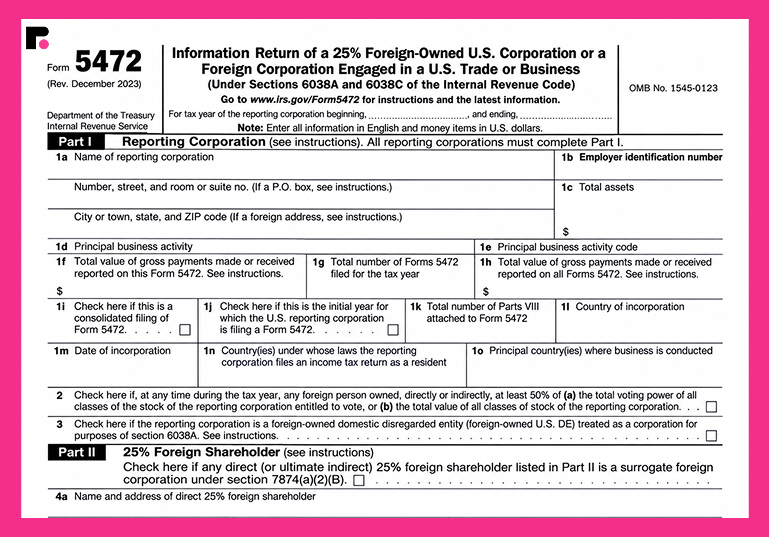
The IRS penalty for failing to file Form 5472 on time is $25,000 per violation, even if the company had zero active revenue. When evaluating maintenance costs, foreign owners must budget for professional tax preparation to remain in good standing.
How Do You Set Up a Delaware LLC?
You can form a Delaware LLC remotely by following these steps:
- Choose a business name: Check that your preferred name meets Delaware's requirements.
- Appoint a registered agent: You'll need an agent with a physical address in Delaware to receive official documents.
- File the Certificate of Formation: Submit the filing and pay the $110 state fee.
- Prepare an operating agreement: This document sets out ownership, management and responsibilities. You don't file it with the state.
- Apply for an EIN: This federal tax identification number is used for tax filings and other business processes.
- Check federal filing requirements: Foreign-owned single-member LLCs may need Form 5472 and a pro forma Form 1120.
Have your identification, ownership details and business information ready before starting.
Banking, Legal Protection and Considerations of a Delaware LLC
Delaware provides an exceptionally predictable legal umbrella. Its Court of Chancery resolves corporate disputes using specialized judges rather than unpredictable juries, providing clear business dispute guidance.
However, Delaware is not a zero-cost or zero-friction tax haven:
- Banking Access Still Requires Diligence: Having a Delaware LLC does not guarantee approval from US tier-1 banks. Financial institutions vet physical operational footprints, beneficial ownership, and regional lines of business.
- Substantial Non-Compliance Penalties: The combination of the mandatory $400 annual state franchise tax and the strict $25,000 Form 5472 penalty makes neglect expensive.
Can You Keep Your Existing Business and Add a Second Entity?
You can keep your existing company and establish a separate legal entity or subsidiary to handle specific business activities. International founders and corporate groups routinely operate multi-entity, hybrid structures to balance legal credibility with operational efficiency.
Why Use a Hybrid Structure?
- Separation of Risk & Operations: Keep your Delaware LLC active for US client-facing contracts, institutional invoicing, and credit facilities, while routing software development, digital marketing, or licensing through a Próspera entity.
- Lean Maintenance: You do not need to cancel or dissolve your Delaware company to capture the regulatory advantages of an economic zone. You can operate both concurrently.
- Optimized Cash Flow: Allocating appropriate overseas engineering, research, or service functions to a 1% effective tax regime can retain substantial liquid capital within your operating group
The new entity can operate alongside your existing business, giving you more flexibility in how you manage different business activities. To make the most of this structure, consider where each company is legally registered, where it is considered a tax resident, and where it conducts its operations.
These factors help determine which tax rules apply to each entity and how you can structure both companies to support your business goals while managing your existing obligations.
Próspera vs Delaware LLC: Which Structure Fits Your Business?
The right choice depends on how your business operates, where your customers are and which legal and tax obligations apply to you.
- Choose a Prospera company if: You are running a borderless digital consultancy, a software company, or an innovation-focused startup that wants automated digital compliance, low friction, and an effective 1% gross corporate tax rate without standard legacy overhead.
- Choose Delaware if: You require direct access to US angel investors or venture capital, have dedicated US domestic operations, or prioritize standard corporate case law above all else.
A hybrid setup makes sense if you want a US corporate face for American client billing and payment processing, supported by an agile, tax-optimized Próspera entity managing international service operations.
Set Up and Manage Your Second Company with Tools for the Commons
Incorporating an entity is only day one. Once formed, modern businesses need to issue invoices, accept cross-border payments, pay global talent, and maintain corporate compliance without getting bogged down across multiple banking portals and spreadsheets.
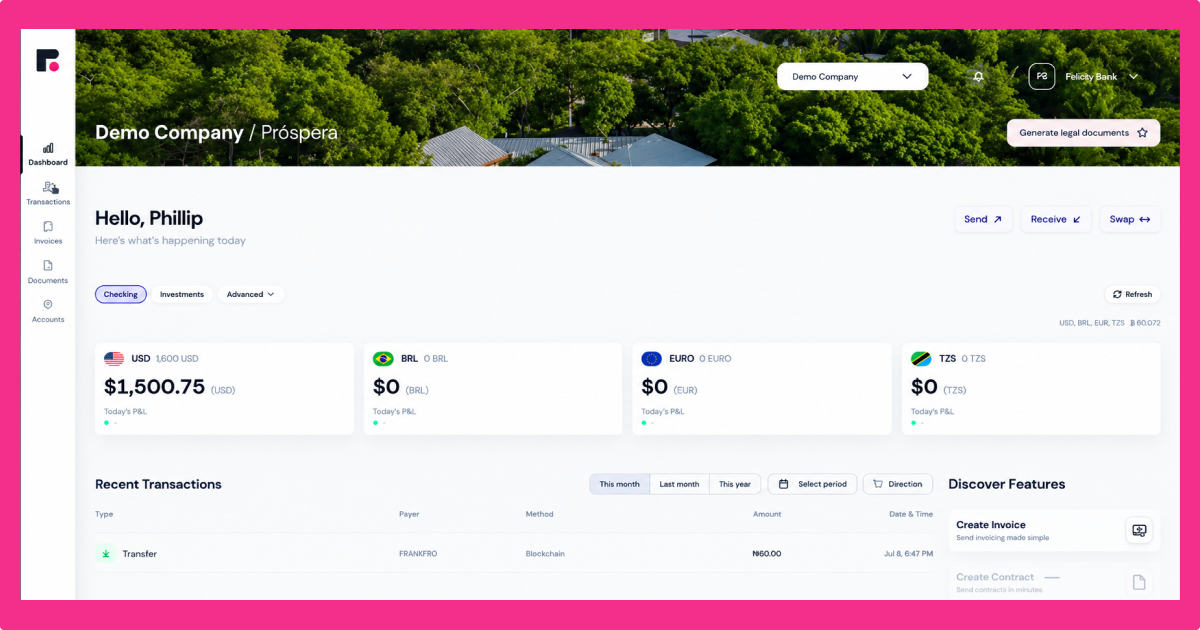
Tools for the Commons provides the end-to-end digital infrastructure for founders operating in next-generation jurisdictions:
- Streamlined Digital Formation: Submit your Próspera registration, complete KYC, and receive your corporate charter completely online without bureaucratic delay.
- Unified Financial Management: Create and send professional client invoices, monitor cross-border balances, and review live cash flow from an integrated business dashboard.
- Automated Operational Maintenance: Keep track of corporate filings, e-Residency renewals, and statutory requirements in one secure platform.
Whether establishing your core business or adding a strategic operating company alongside your Delaware LLC, TFTC eliminates operational friction.
Explore Próspera company registration with Tools for the Commons.
Frequently Asked Questions
Which costs less to maintain, a Próspera company or a Delaware LLC?
Próspera generally has a lower fixed regulatory cost, with baseline recurring expenses around ~$380/year covering e-Residency and registered address services. Delaware requires a mandatory $400 state franchise tax plus 50–300 for a registered agent. Additionally, foreign Delaware owners must budget for annual IRS Form 5472 preparation to avoid steep non-compliance fines.
Can I register a second company while keeping my existing business?
Yes. You do not need to dissolve your Delaware LLC. Many founders maintain a Delaware entity for US-facing operations and establish a Próspera subsidiary or parallel operating company to manage cross-border services and IP under an effective 1% tax rate.
Does a Próspera company or Delaware LLC reduce my taxes?
Not automatically. Your tax obligations depend on your tax residency, business activities, income and applicable laws. Registering in either jurisdiction doesn't by itself remove taxes you may owe elsewhere.
What US filings does a Delaware LLC have if I am not a US resident?
Foreign-owned single-member LLCs may need to file Form 5472 with a pro forma Form 1120. Multi-member LLCs taxed as partnerships generally file Form 1065 and issue Schedule K-1s. Requirements depend on the LLC's circumstances.
Can I register a Próspera company online?
Yes. You can apply online through Tools for the Commons. Simply create an account, verify your identity and submit your company details. Once approved and registered, your documents are sent by email.
How does Tools for the Commons simplify company formation?
Tools for the Commons acts as an all-in-one registration and operational platform. Instead of coordinating separate lawyers, registered agents, and filing portals, TFTC guides you through remote identity verification, submits your incorporation paperwork, and equips you with a financial management dashboard to run day-to-day operations.
